Introduction
Before we dive into the article, here is a link to the YouTube video if you’d prefer to view that!
Not too long ago I published an article on here about the what the best cheap daily drivers would be for an enthusiast (read that article here, check out the YouTube video here). The inspiration for that article came from the fact that I am planning on buying my first “fun” car very soon. But I also need this car to be my daily driver, hence why the research in the article was meaningful to me.
I learnt quite a few things after writing that article and publishing the related videos. Firstly, I learnt that everyone’s definition of cheap is different, I threw a budget of approximately $30k CAD down and that was my mistake. Cheap is a subjective term, which is why this article is now titled as the best daily drivers around $30k CAD. It was initially titled as the best affordable daily drivers, but affordable is unfortunately also a subjective term. So the only way around it was to outright list the budget I’m working with here.
Secondly, I learnt that there are many great options out there that lie within this segment. And by segment, I am referring to cars that can be fun daily drivers. Meaning 4 doors, front or all wheel driver and a fun power/drivetrain.
Prior to writing that article I was dead set on getting an 11th gen Civic Si. Now? Not so much. Don’t get me wrong, the Si is still a great car and remains in my top 3, but there are also options out there that should be considered too. Options that I never considered to prior to doing the research for that article.
I had the Si on a pedestal above all the other cars that popped into my mind, but after doing my research that pedestal was shattered (quite literally by the power of knowledge).
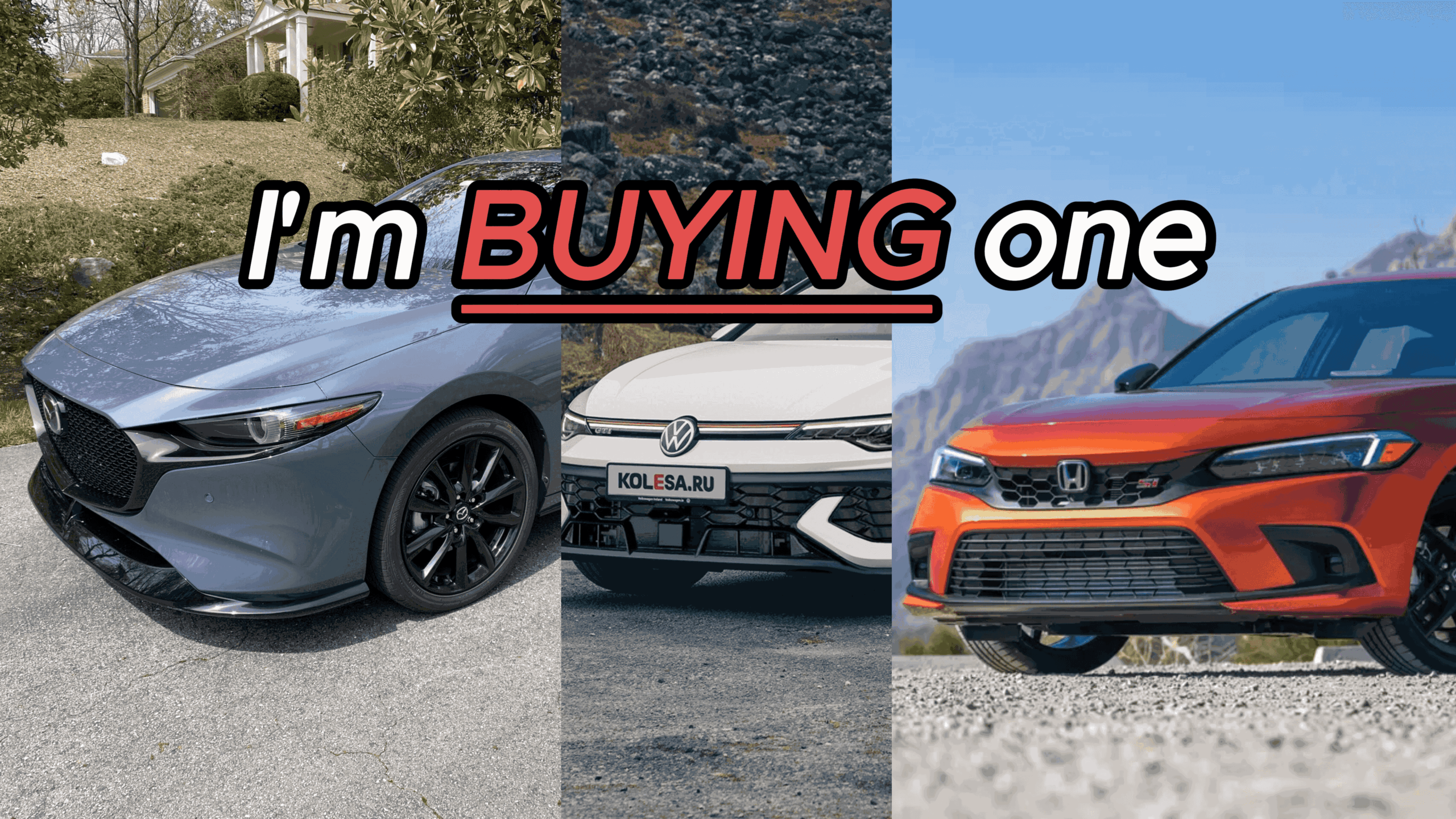
Now my top 3 cars are, in no particular order, the 4th Gen Mazda3 Turbo hatchback, 11th Gen Civic Si and the Mk8 Golf GTI. In the following sections we’ll dive into what makes each of these cars great, and also what may make them not so great.
Given that I’ve already done a preliminary evaluation of these cars in my previous article (read that article here), I won’t re-evaluate simple things like their looks or whether they have 4 doors. Instead, I’ll be focusing on criteria that will allow me to compare and contrast them in ways that matter to me.
Mazda3 Turbo (4th Gen Hatchback)

- Stock Power: Good
- Stock Driving Dynamics: Ok
- Price: Great
- Comfort / Practicality: Great
- Performance Potential / Aftermarket Support: Ok
From the factory the Mazda3 Turbo makes 250 horsepower and 320 lb-ft of torque when given 93 octane fuel, however if given 87 octane fuel these power numbers drop to 227 horsepower and 310 lb-ft of torque. It is impressive that with such a significant drop in fuel octane the Mazda only loses 10 lb-ft of torque.
If we take a look at acceleration the Mazda can move from 0 to 100 kmph (60 mph) in about 5.6 – 6 seconds. Unfortunately, I can’t find a way to source reliable lap times for this car, there is an approximated Nürburgring lap time of 8:30 – 8:45.
If we shift gears (no pun intended) towards the driving dynamics, we’ll find that this car continues to exhibit some interesting characteristics. It does come with all wheel drive from the factory, which will help it gain some points in both driving dynamics and practicality (read my article about drivetrains here).
The rest of its drivetrain features a 6-speed torque converter automatic and open differentials, though it does offer brake vectoring to help simulate a limited slip differential. It is also worth noting that this car does utilize a torsion beam rear suspension, not an independent rear suspension.
Many reviews note that the 6-speed automatic is good for daily driving, but is slower than a DCT automatic and less engaging than a manual transmission. Reviewers have similar sentiments towards the torsion beam rear suspension, it is good, but not as good as independent rear suspension.
The suspension is also on the softer side, as it is tuned to offer a comfortable ride, not necessarily a sporty one. Furthermore, the power band for the Mazda peaks in the middle of its RPM range, causing power to fall off in the higher RPMs. This is great for driving around town and quickly getting up to the speed limit, but can be unexciting in spirited driving.
While its driving dynamics may not seem impressive, its value proposition is a different story. On the used market you can find these going for less than $30k CAD quite regularly. What the Mazda lacks in excitement, it makes up for luxury and comfort.
From the factory the turbo models come with leather seats, a 360 camera, comfortable ride, 8 speaker Bose sound system that reviewers love and an overall gorgeous interior. It’s all wheel drive system and the fact that it is a hatchback earns it points for practicality as well. The only downside is that the rear seats are quite small, which is a drawback if you intend to regularly carry adults in the back.
Finally, we arrive at aftermarket support and performance potential. On paper it sounds like a 2.5L turbo motor should have plenty of tuning potential, however, the tuning scene for the Mazda3 Turbo isn’t nearly as popular as it should be.
There are limited tuning options for the platform, with the 3 most popular options seeming to be DRTune, Mazda Sauce and a JB4. The DRTune doesn’t have the best reviews, with users in the Mazda forums reporting various problems that arose from it. A JB4 isn’t quite a tune per se, it gets the turbo to make more boost by messing with the values that sensors report to the ECU.
Leaving the only seemingly reliable option to be the Mazda Sauce tune, and to be fair it does have several great reviews online. However, it doesn’t appear to be sold through a website, it seems to be a single person that you need to email for the tune.
There is aftermarket support for the Mazda3 Turbo, though it isn’t quite as large as what exists for more established tuner cars.
Honda Civic Si (11th Gen)

- Stock Power: Ok
- Stock Driving Dynamics: Great
- Price: Good
- Comfort / Practicality: Good
- Performance Potential / Aftermarket Support: Good
From the factory the 11th Gen Civic Si makes 200 horsepower and 192 lb-ft of torque, which aren’t stellar numbers by any means. The Si will get from 0 to 100 kmph (60 mph) in between 6.8 and 7.1 seconds, which again, not stellar numbers either. While no official lap time exists for the Si on the Nürburgring, Car and Driver did set a lightning lap time of 3:16.9 on the Virginia International Raceway.
Although the performance numbers aren’t exciting, many reviewers rave about the driving dynamics of the Si. It comes equipped with a limited slip differential, independent rear suspension, front wheel drive and perhaps the best manual transmission in its class. The handling of the car is a recurring highlight amongst reviewers.
Many reviewers also express that the car is very fun to drive, due to the sentiment that it is more fun to drive a slow car fast than a fast car slow. The Civic Si doesn’t make that much power, which means you can shift through a few gears and really push the car to its limits without hitting felony speeds.
However, many owners reveal that this is a double-edged sword, arguing that that the car is only fun when being pushed to its limits. This can tend to make the car feel like its always struggling, so if you don’t enjoy always revving out your car and prefer more casual fun not at the limit, then this is a point worth considering.
The Si can be found for around $30k CAD used which is a fair price for what the car offers. The limited slip differential, great manual transmission and exceptional handling can warrant this price tag to the right buyer.
The Si will come with heated seats (front and rear), a heated steering wheel, and a 12 speaker Bose sound system from the factory. These are a decent list of creature comforts I think, nothing exceptional but also not disappointing. Also note that I am speaking about the Canadian model here.
The Si also has exceptional rear seat room and a decent sized trunk which does earn it some points for practicality. The limited slip differential can also help the front wheel drive system perform well in inclement weather.
There is strong aftermarket support for the Si as it is one of the oldest tuner cars on the market, and as a result there has been ample time for various aftermarket brands to establish themselves. There are reputable off-the-shelf tunes available for the platform, from companies such as Phearable and Two Step Performance (often administering their tunes through KTuner or Hondata).
These tunes can reliably take the car up to 240 horsepower with very limited bolt on modifications, however the platform is limited in its performance potential. The 1.5L turbo motor that powers the Si doesn’t have much headroom to make more power.
Typically you would need upgraded headstuds before attempting to go beyond 240 horsepower, along with full bolt-ons and a new clutch. Furthermore, these motors seem like they tend to approach their limits around 350 lb-ft of torque. So despite having good aftermarket support, the platforms performance potential is hardware limited.
Volkswagen Golf GTI (Mk8)

- Stock Power: Great
- Stock Driving Dynamics: Good
- Price: Ok
- Comfort / Practicality: Good
- Performance Potential / Aftermarket Support: Great
From the factory the Mk8 GTI makes 241 horsepower and 273 lb-ft of torque out of a 2.0L turbo motor. These are very respectable power numbers, more so when you consider it makes this power on 87 octane fuel.
The Golf can move from 0 to 100 kmph (60 mph) in between 5.1 and 6 seconds. This is quite a range but it is worth noting that the Mk8 GTI can be equipped with either a 7 speed DSG automatic or 6 speed manual which will cause a variance in these times.
The Mk8 GTI has a Nurburgring lap time of 7:46.13 and Car and Driver set a lightning lap time of 3:11.4 on the Virginia International Raceway. These are also very respectable numbers in my book, especially considering that the GTI is front wheel drive.
As was previously mentioned the GTI can be equipped with either a 7 speed DSG automatic or 6 speed manual transmission. In addition to this the front wheel drive hatchback is also equipped with a limited slip differential. Reviewers do mention that the manual isn’t the greatest transmission in the world and could use improvement, and while the DSG is blisteringly fast, you lose the engagement that a manual transmission offers.
That being said, the 241 horsepower the car has does make it more exciting to drive on the daily commute when met with a clear stretch of highway. Additionally, many reviewers note that the car does handle quite well.
The GTI is priced higher than many others in its segment, typically going for between $31k and $35k CAD used depending on what trim level you are after. The base model does come with a good amount of creature comforts, with the higher trim levels unlocking things like memory & leather seats, true keyless entry and heated rear seats.
The rear seat room is decent, not quite impressive but also not terrible enough for reviewers to harp on. The hatch offers quite a bit of cargo space and reviewers do tend to rave about this. The GTI offers a fairly quiet and comfortable ride too when being driven in a relaxed manner, which earns it points for comfort.
The GTI has been around for a few decades now, and because of that, the aftermarket scene for the car is well established. There are several reputable tuning companies in operation, with off-the-shelf tunes easily and reliably making over 300 horsepower with minimal bolt-ons. If you add an aftermarket downpipe to your existing stage 1 bolt-ons, a stage 2 tune can take you to over 400 horsepower.
The GTIs 2.0L turbo has plenty of performance potential in it, which when coupled with the large aftermarket and tuning scene is a deadly combination.
Comparison
- Stock Power: GTI
- Stock Driving Dynamics: Civic Si
- Price: Mazda3
- Comfort / Practicality: Mazda3
- Performance Potential / Aftermarket Support: GTI
Now that we’ve taken a look at each of these cars individually, it’s time to pit them against each other and crown one of them the winner, which I will likely be buying in the near future.
Let’s start off with the comparison of stock power first. The Civic Si brings in the lowest stock power numbers with 200 horsepower and 192 lb-ft of torque, and if we’re speaking strictly about power numbers then the Si lands itself at the back of pack.
However, the comparison between the Mazda3 Turbo and GTI isn’t as clear. The Mazda does technically make more power stock than the GTI with its 250 horsepower against the GTI’s 241 horsepower, but only when given 93 octane fuel. If we give both of the cars 87 octane fuel then the GTI will continue to make 241 horsepower while the Mazda will drop to 227 horsepower.
Given that the Mazda can’t match the GTIs power across all fuel levels, I have to crown the GTI the winner of this category.
Moving into the driving dynamics tells a very different story than the power numbers. I want to preface this by saying that the Mazda handles very well and will handle better than 95% of the cars in its price range. But unfortunately, it has been put up against that other 5% right now.
The Mazda comes with torsion beam rear suspension and a 6-speed torque converter automatic, which again are good, but fall short against this competition. Many reviewers note that the torsion beam rear suspension handles well and you only really notice it at the limits. However, reviewers do conclude that the torsion beam rear suspension is simply not as good as independent rear suspension.
Much of the same is true for the torque converter automatic, it is good and far better than a CVT, but cannot compete with any of the transmissions found in its competition. The 6-speed manual in the Civic Si is likely the best in its class and offers far more engagement than the Mazda can. The GTI can either come with a 6-speed manual or a 7 speed DSG, both of which out class the Mazda’s 6-speed.
The Mazda’s all wheel drive system does help, but isn’t enough to overcome to the short-comings of its suspension and transmission. So when it comes to transmission and handling, its safe to say the Mazda is at the bottom in this group. Now the comparison between the Civic Si and GTI is fairly simple in my mind, but does require some explanation.
Both the GTI and Si are front wheel drive, have independent rear suspension an have good transmission options. The manual transmission in the GTI isn’t perfect, and does fall a good bit short of the transmission in the Si. The DSG in the GTI is blisteringly fast and many reviewers note that it is a joy to use, but as an automatic it can’t offer the same level of engagement that the manual in the Si does.
When it comes to handling we must acknowledge that these are two great cars, likely competing for the top spot in their class. There are no shortage of comparisons between the two cars as well. Most reviewers end up concluding that the Si is the better handler, it has sharper steering and rotates easier during turns. With that I conclude that the Si wins in both the transmission and handling category.
The last aspect of the driving dynamics to discuss is the power band. The Mazda’s power band peaks in the middle of its RPM range, which causes it fall off in the higher RPMs. This type of power band is great for driving around town and getting up to the speed limit, but isn’t the best for spirited driving if it falls off in the higher RPMs.
The power bands of both the GTI and Civic Si are different in the sense that they do not fall off in the higher RPMs and scale more linearly. The Si does make peak torque early in the range, but does not necessarily fall off either. I think that the GTI does have a slightly better power band than the Si, but they are so close in comparison that I’d call the power bands a tie between the two.
Therefore, the Si is our winner for the driving dynamics category, and we can move forward into the pricing segment. If we consider price alone as a metric, the Mazda3 is the winner because it is available at the lowest price of the 3.
However if we instead consider the value propositions of the 3 cars, things quickly become messy. For example, if we look at the value in terms of luxury features then the Mazda3 is once again the winner. However, if we consider the value in terms of handling and driver engagement, then the Si is the winner.
As you can likely see, value isn’t a metric we can consider because it is highly subjective against what you value most. Hence, I am forced to declare the Mazda3 the winner of this section simply because it is the cheapest of the 3.
Now we enter the conversation about practicality and comfort, which is an important one. If this is a car that you’re going to be driving everyday, then you’d want it to be both comfortable and practical. Furthermore, there are several different aspects of this category worth considering.
If we look at gas mileage / fuel efficiency then the Si comes out on top with its 1.5L turbo motor. Another important aspect is handling any weather condition, all 3 of these cars will handle inclement weather well but the Mazda will get the edge for having all wheel drive.
The interior space of the Mazda3 is a joy to be in, which makes it great for everyday commuting. Its suspension is also softer than the others which lends itself well to a relaxing and comfortable commute. The Si interior has suffered from complaints of having random rattles, whereas the GTI is plagued by random glitches and a lack of buttons.
Another aspect of practicality is being able to comfortably fit 4 adults. The Mazda has the worst back seat space of the bunch, with the GTI not being much better and the Civic Si easily defeating them both. Given all of this, I am comfortable crowning the Mazda3 as the winner of the comfort and practicality section.
The final section left to discuss is the aftermarket support and performance potential of each car. Let’s start with the winner of the previous category, the Mazda3. On paper, the Mazda3’s 2.5L turbo motor seems like it should have a lot of performance potential in it, and while that may be true, the platform lacks tuning support.
Moving forward to the Civic Si we do find some reputable tuning companies, such as Phearable and Two Step Performance. On this platform off-the-shelf tunes with minimal bolt-ons can easily make 240 horsepower. However, if you want more power you’ll need to upgrade your headstuds and clutch, as well as getting full bolt-ons.
Finally we arrive at the GTI, which has several reputable tuning companies available for the platform. Stage 1 tunes with minimal bolt-ons easily surpass 300 horsepower, adding in a downpipe can allow the platform to surpass 400 horsepower.
I don’t think my ranking here really needs anymore justification, to me the GTI is the clear winner in this section. To summarize, the power winner is the GTI, the driving dynamics winner is the Si, the price winner is the Mazda3, the comfort & practicality winner is the Mazda3 and the aftermarket support winner is the GTI.
Conclusion
The perhaps unsurprising conclusion here is that the true winner really depends on what you want – which is what I started getting at when speaking about the value proposition of each car earlier.
Are you after the purest and rawest driving experience? Then the Civic Si is the clear choice. Are you after the most comfortable drive that offers some sportiness? Then the Mazda3 is your winner. But what if you aren’t after either of the extremes? That’s where the GTI slots in.
It can give you about 80% of the luxury and comfort that the Mazda offers, 80% of the handling and engagement of the Si, while offering more power and aftermarket support than both of them. For me personally, the GTI is the winner. I’m shopping for a do everything car, I don’t really want to be at either extreme, I want the car than can do it all.